

The Case for Inshore Baitcasters
Happy Monday Spacefish!
Merry Christmas! Today I am going to dive into the world of tackle talk, and make the case for why baitcasters belong in the inshore anglers arsenal. Over Thanksgiving break I decided to get back into more baitcaster use on the inshore side of my fishing game.
I think I speak for many inshore anglers along the Space Coast when I say, we don’t exactly fish wide-open water — we fish mangrove edges, pilings, sea walls, rocks, docks and every piece of structure that wants to steal your lure and your dignity. While spinning gear will always have its place inshore, there’s a strong case to be made for picking up a baitcaster once you’re ready to level up, or try something new. Casting rods shine when accuracy and control matter most, due to their design, they are meant for anglers that make a living throwing artificials.
That’s why a baitcaster really earns its keep inshore. While spinning gear is friendly and forgiving, a casting setup gives you next-level accuracy, control, and backbone when you’re pitching paddle tail jigs or shrimp lures into tight pockets in a mangrove shoreline, dropping baits on pilings of docks in the Indian River Lagoon, casting right in front of the face of a rolling Tarpon or trying to horse a quality redfish or snook away from danger. The thumb control, trigger grip, and smaller guides mean better sensitivity, and stronger hooksets. Once you get past the learning curve, a baitcaster isn’t harder. It is a lot of fun, and over time, is much easier to cast over, and over again. Pictured below is my most quality inshore fish caught on a baitcaster – Merry Christmas!

Big Fish on a Casting Reel
The Ghost of Baitcasters Past
Prior to my new setup I got Thanksgiving week, I have not had a good all around baitcaster since my last Lew’s Inshore Speed Stick was tragically murdered by Hurricane Nicole in 2022. Well, technically Nicole murdered our shed, and the collapsing roof is what killed my rod, but I digress.
I went looking for a picture of a nice fish caught on that set up, and I came across photos from one of my last trips with that rod. It was my first time fishing Sam’s Creek on a warm October day. I had an awesome time that day catching Juvenile Tarpon. One of the reasons I was able to catch so many that day was being able to make quick, and accurate casts with a small swimbait, if memory serves me correctly I would have been using the 2 or 3 inch Storm Wild Eye Shad weighing between ⅛ Oz or ¼ Oz.
I was trying to find a good Tarpon picture, I came across one from a photo burst that I thought was just too good not to share. I was trying to hold the Tarpon for a picture and it started pooping all over me, what a time to be alive. Merry Christmas everyone. My gift to you all is showing you a photo of myself being dumped on by a Juvie Tarpon.
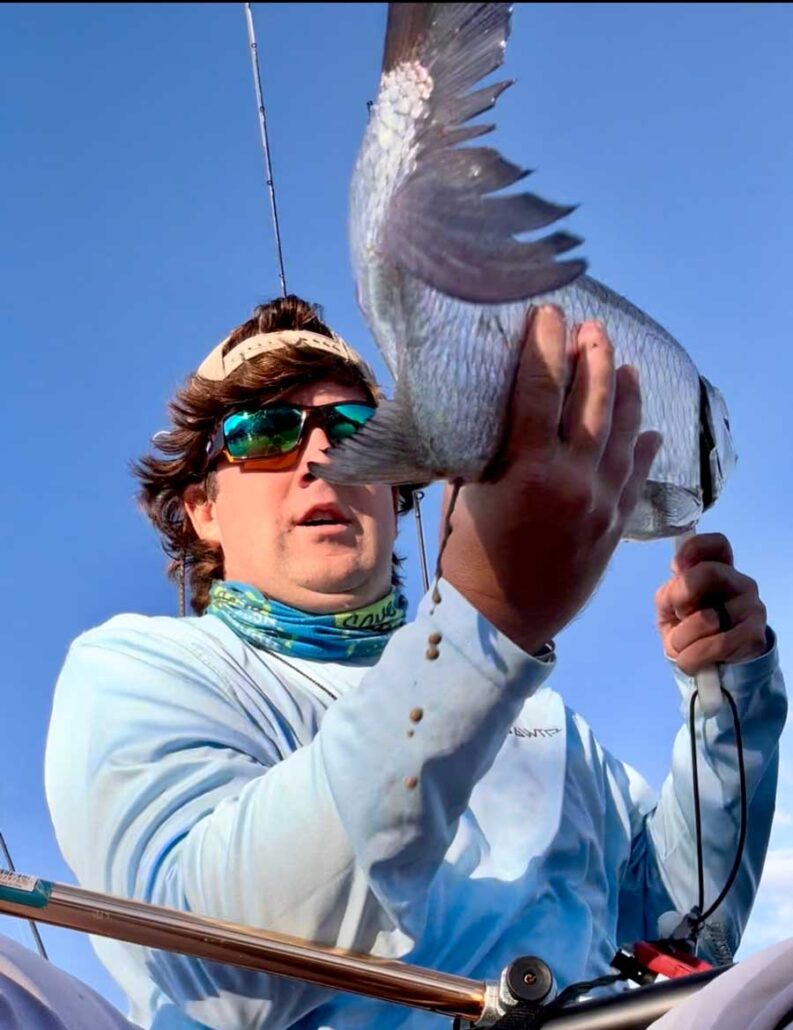
Speed Stick Tarpon - Pooping
The All Around Game – Lew’s Xfinity Inshore Speed Stick
Rod:
I have the 7 Medium casting rod, which has been perfect for inshore fishing techniques in the Lagoon system. Enough backbone to turn fish, but still light enough for all-day casting and capable of casting baits with weights as light as 1/16 of an ounce.
Reel:
Low-profile baitcasters with smooth, adjustable brakes are your friend. You don’t need a rocket launcher — just something comfortable with a solid drag for when a Snook or Redfish decides to run for structure. I recently just got a Piscifun Torrent II, on sale off of Amazon and it’s been working really well for me. Back during my previous stint I used a cheaper Quantum bait caster and it got the job done. For the price point the reel has been very smooth, and has a fast gear ratio, allowing me to pick up more line per turn.
Line:
Since I re-created the set-up, I have been using a Reaction Tackle braid, in grey. I have been using a 15 pound test, which is a little heavier than I used on my spinners, but lighter than most Bass fishing applications. When inshore fishing, line size matters. The thicker your braid or leader is, the more likely it will be to spook fish, but if it’s too light or then, you will never land quality fish. It’s a bit of a tightrope walk. Also, thinner diameter braid casts further. The ability to hit the target from further back will end up in much larger quantities of fish caught per trip.
I got this setup wanting to have a good all around combo that would throw not only topwater plugs, but 3-4 inch paddle tails on ⅛ oz jigs, and 3 inch shrimp lures with ⅛-¼ oz weight to them. So far it has been delivering well, and casts the baits with the ⅛ oz jig really well. It has been well worth the $130ish spent on rod, reel, and line. As far as quality gear goes, this entire set up is definitely on the more budget friendly side.
I especially like fishing a Shrimp on a baitcaster. My exact words in a recent report talking about fishing these shrimp…
“Lately for me, the strikes come from a slow drag and the occasional twitch. Typically for the paddle tails, or jerk baits I twitch it in more of sidearm manner, but for the shrimp, I like to make a more vertical action, to make the action as lifelike as possible, I make it look like a scared shrimp popping off the bottom, then I let it settle and drag a few more feet, pause and repeat. This is the method that has been working the best for me. I also generously slather Pro-Cure “Shrimp” on the bait every 25-30 casts. I caught a good number of Trout on the Vudu, and a good number of Snook as well. The Trout will take it in a variety of ways, but for the Snook, they almost always pick it up when it’s sitting on the bottom on a dead stick technique, or will hit it on the fall after a pop.”
Fishing a shrimp lure like this on a bait caster reminds me a lot of how I fish a Texas Rigged creature bait, or stick/trick worm when Bass fishing.
When it comes to the paddle tails, I like a slow-roll retrieve with pauses or the occasional twitch. If the fishing is slow, I will start dragging it on the bottom, or will start bouncing it off the bottom. Pretty much the way I would work a speed worm.
I also have been looking for opportunities to park the kayak and wade shallows in areas with clean water. I really like having an accurate, quick draw weapon in my hand while wading.
Pictured below are two recent fish I have caught using this setup. A Snook on a Vudu Shrimp, and a Trout on a DOA CAL Shad.

Speed Stick Snook
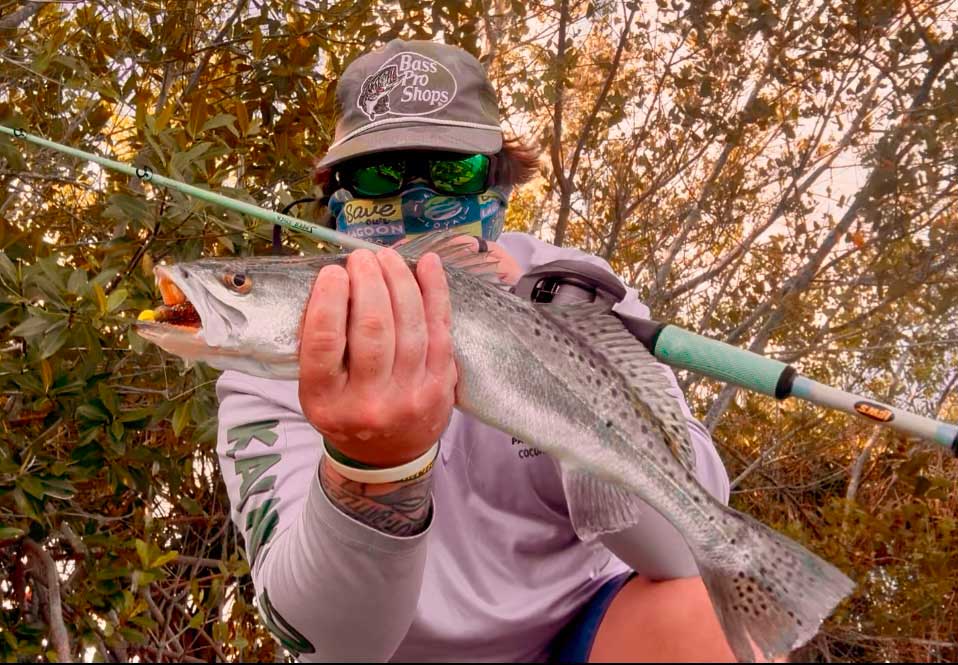
Recent Trout on Speed Stick
Conclusion
Is there a learning curve to using a bait caster? Sure. You might have to sacrifice a backlash or two to the fishing gods. But once it clicks, a baitcaster can give you more control, more power, and more confidence.
I’d like to wish you all a very Merry Christmas, and sincerely thank you for taking the time to read this report. Speaking of Christmas, for those looking for a last minute stocking stuff, don’t forget to swing into Kayaks By Bo!
Stay safe, be happy, have a Merry Christmas, and go catch a few fish this week!


Leave A Comment
You must be logged in to post a comment.