
Happy Monday Spacefish!
I thought I was done with ICAST, but this past week we cranked up football, and this past weekend I was in Georgia for my nephews birthday party, so no fishing for me. I decided to write a piece about the new VoyaX MOSSA series of fishing kayaks. These two boats won the best in show award for Best Boat or Watercraft this year at ICAST. Now please understand this, I fish in a used Hobie Outback with no motor of any kind, and I do not use electronics of any kind. I stopped by the VoyaX booth and got the rundown on these boats, but I I don’t have experience with anything this fancy. Let’s dive in…
Walk the floor at ICAST long enough and you start to notice a pattern; Another glide bait, another soft plastic, another fuzzy ball urchin bait in a slightly different color. Most years, the biggest innovations in fishing are really just small refinements to products we’ve already been using for decades. That’s not necessarily a bad thing, good ideas evolve over time, but every once in a while a company shows up with something that makes you stop and think, “This could actually change the way people fish.”
The VoyaX MOSSA 128 was one of those products for me. Rather than building another premium pedal kayak, VoyaX has taken a different approach. Instead of asking anglers to spend thousands of dollars adding a trolling motor, GPS anchor, batteries, steering cables, and mounting brackets after buying their kayak, they designed those systems into the kayak from the very beginning. Whether it becomes the future of kayak fishing remains to be seen, but it was easily one of the most interesting products I saw at ICAST 2026.
The Arms Race of Modern Kayak Fishing
Kayak fishing has changed dramatically over the last decade. Not long ago, owning a pedal kayak meant you were fishing from one of the most advanced platforms on the water.
Today, that’s often just the starting point. It’s become common to see premium pedal kayaks rigged with bow-mounted trolling motors, lithium batteries, fish finders, forward-facing sonar, Power-Pole anchors, and enough wiring to rival a small bass boat. The result is an incredibly capable fishing machine…but also one that’s expensive, complicated, and often weighs well over 200 pounds before you load a single tackle tray.
The MOSSA 128 asks a different question. What if all of those systems were designed to work together from the very beginning instead of being added one piece at a time?
One Drive With Everything Built In.
At the heart of the MOSSA is what VoyaX calls the Spot Hold Drive. Instead of separate pedals, steering cables, rudders, and a trolling motor, everything is integrated into one removable drive unit. Drop it into the drive well, lock it in, and go fishing.
The system offers four ways to move the kayak:
- Manual Pedal Mode
- Sync Assist, where the electric motor amplifies your pedaling effort
- Full Electric Mode
- Powered Reverse
Perhaps even more impressive is the steering system. Rather than using cables connected to a rudder, the MOSSA features electronic, cable-free steering with unlimited 360-degree rotation. That means there are no steering stops. You can rotate continuously in either direction, making it remarkably easy to work docks, mangroves, bridge pilings, oyster bars, or any piece of structure where precise boat positioning matters. For anglers who spend their days picking apart shoreline cover, that’s a genuinely intriguing feature.
Built-In Spot Hold
The feature that generated the most conversation at ICAST was undoubtedly Spot Hold. If you’ve ever used a GPS-enabled trolling motor, you already understand why. Press a button, and the kayak automatically holds its position against wind and current. There’s no anchor rope, no stakeout pole, and no constantly correcting your drift.
Whether you’re fishing a bridge piling under a causeway, a mangrove point on the Indian River Lagoon, a shell bar on the St. Johns, or a grass point on Lake Toho, being able to stop exactly where you want without taking your hands off the rod has obvious advantages.
Traditionally, that capability required adding an expensive bow-mounted trolling motor. With the MOSSA, it’s simply part of the kayak.
Designed for Real Fishing
Beyond the drive system, the rest of the kayak looks thoughtfully designed. The MOSSA 128 measures 12 feet, 8 inches long and 37 inches wide, providing a remarkably stable platform for standing and sight fishing. It carries up to 580 pounds, offers nearly 40 gallons of combined storage, features long accessory tracks on both sides, and includes onboard power options for electronics.
Reviewers who have spent time on the water consistently praise its stability and maneuverability, noting that it feels more like standing on a small skiff than a traditional kayak. For anglers who like to customize their rigs, the open accessory tracks should make adding rod holders, camera mounts, fish finders, and other accessories relatively straightforward.
Who Is the MOSSA 128 For?
Not every angler needs an electric fishing kayak, in fact, many don’t. But after seeing the MOSSA in person, I can think of a few groups who may benefit most.
#1 Tournament anglers: will appreciate the efficiency. SpotHold, powered reverse, and unlimited steering make it easier to thoroughly fish docks, bridges, grass lines, and oyster bars without constantly repositioning the kayak.
#2 Anglers who still enjoy pedaling; but appreciate a little help: may find the Sync Assist mode especially attractive. Anyone who’s fought a stiff southeast breeze across the Indian River Lagoon knows that saving energy on the return trip can mean fishing longer and enjoying the day more.
#3 Technology-minded anglers: looking for an integrated system instead of piecing together aftermarket components will probably find the MOSSA particularly appealing.
On the other hand, anglers who value absolute mechanical simplicity may still prefer a traditional pedal kayak. One of the biggest discussions online has centered around long-term serviceability. Because the drive system is proprietary and electronically integrated, questions remain about repairs, replacement parts, and how the electronics will hold up after years of exposure to Florida’s saltwater environment. Those are fair questions, and only time can answer them.
Innovation Always Comes with Risk
One thing I appreciated about the MOSSA is that it isn’t trying to copy someone else’s homework. Walking ICAST, I saw dozens of companies making nearly identical products.
The MOSSA wasn’t another version of something already on the market. It was trying to rethink the entire platform… Will it become the next major evolution in kayak fishing? Maybe. Will it prove to be an ambitious experiment that helps push the industry forward even if others ultimately perfect the concept? That’s possible too. Either way, it’s refreshing to see genuine innovation in an industry that sometimes feels content to recycle yesterday’s ideas.
Final Thoughts
I don’t believe the MOSSA 128 is going to replace every Hobie Outback or Old Town PDL overnight. Those kayaks have earned their reputations through years of proven reliability and hundreds of thousands of days on the water. But I also wouldn’t dismiss the MOSSA as just another flashy ICAST product.
Integrated steering, pedal assist, full electric propulsion, reverse, and GPS SpotHold packaged into one factory-designed system represents one of the most innovative products I saw at this year’s show.
The real test, however, won’t be the demonstrations on a convention floor. It will be how these kayaks perform after years of saltwater, oyster bars, blazing Florida summers, and countless launches before sunrise. That’s where real reputations are made.
Perspective & Final Thoughts
One thing I’ve learned over the years is that the best technology doesn’t replace knowledge, if anything, it can amplify it. A GPS anchor won’t tell you which shoreline will hold bait on a falling tide. Electric assist can’t teach you why bait stacks up on one point but not another. Unlimited steering won’t matter if you’re making perfect casts to water that doesn’t hold fish. As the kids would say, “you gotta know ball.”
Those lessons still come from paying attention to tides, wind, water clarity, seasonal movements, and fish behavior. If the MOSSA helps anglers spend less time fighting the wind, or repositioning their kayak, and more time observing the water in front of them, then it’s doing exactly what good technology should do. Because in the end, the goal isn’t to own the most advanced kayak on the water. It’s to become the kind of angler who knows where the fish are before the electronics ever have to tell you.
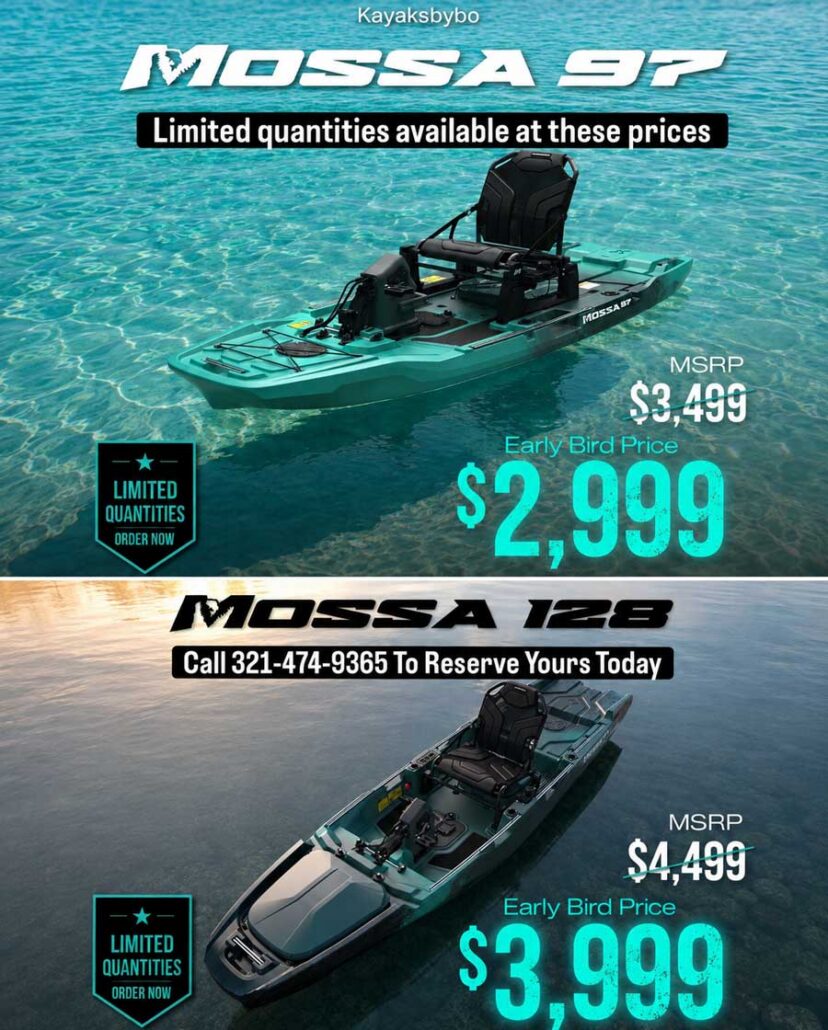
If the MOSSA 128 caught your attention, there’s some good news for anglers here on the Space Coast. Kayaks By Bo is now taking reservations on the first shipment of both MOSSA models, and they’re offering introductory early-bird pricing for a limited number of kayaks. The MOSSA 128 carries an early-bird price of $3,999 (regular MSRP $4,499), while the compact MOSSA 97 is available for $2,999 (regular MSRP $3,499).
As always, I encourage anglers to do their homework, ask questions, and (if possible) get out for a demo before making any major purchase. A kayak is one of the biggest investments many of us make, and the best one is the one that fits your style of fishing.
One thing is certain: the VoyaX MOSSA is one of the most innovative products I saw at ICAST 2026. Whether it proves to be the future of kayak fishing or simply the beginning of a new direction for the industry, it’s a platform worth paying attention to; and if you’re interested in getting one of the first MOSSA kayaks on the Space Coast, Kayaks By Bo is accepting reservations now, but with only a limited number available at the introductory pricing, waiting too long could mean missing out.



Leave A Comment
You must be logged in to post a comment.